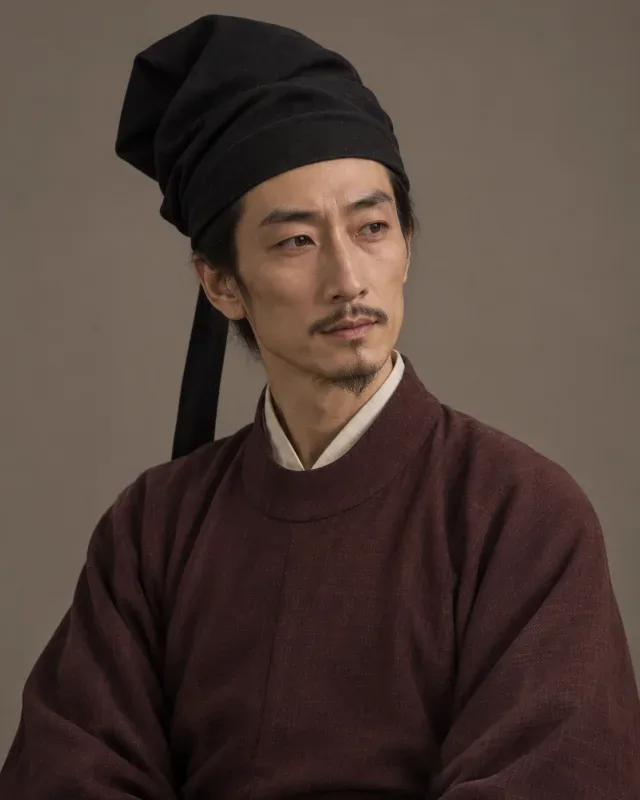
From Liu Sanbian to Liu Tuntian
- Names and courtesy names
- Originally Liu Sanbian, courtesy name Jingzhuang. Later Liu Yong, courtesy name Qiqing.
- Art name and sobriquet
- No securely documented self-chosen art name. Liu Tuntian comes from his official title.
- Life dates
- Northern Song, c. 987–c. 1053. Both dates are disputed.[1]
- Origins and places
- Chong’an, now Wuyishan, Fujian. Sat the examinations in Bianjing and later held a succession of posts.
From examinations to office
Liu spent years taking the examinations before entering government service. Ye Mengde’s notes remember both his dealings with musicians and his later official career. The story of “Liu Sanbian, lyricist by imperial command” is best read as an anecdote. It preserves an image of an unruly songwriter, while the precise examination events and words attributed to the emperor need separate evidence.[2][1]
Songs preserved on paper
The Yuezhang ji reached readers through copying and printing. The Siku catalogue records an earlier listing in several volumes, whereas the copy seen by its compilers had been combined into one. The change is a clue to three different stages of transmission: lyrics sung by musicians, collections printed by booksellers, and the works that remain readable today.[2]
The boat has yet to leave
Liu Yong was earlier known as Liu Sanbian. Song period notes connect him with musicians of the court entertainment bureau and record that he later held the rank of Tuntian Yuanwailang, a Song government post that gave him the name Liu Tuntian.[2] A good way into his longer lyrics is to hear how a farewell can stretch across a single question.
The night imagined in advance
Yu Lin Ling opens with drinks at a farewell tent, a boat urging departure, and two people holding hands. The question of where the speaker will wake sober comes later. That riverbank belongs to a night imagined from the farewell itself. At the stanza break, track what has happened and what the speaker can already picture.
Two people looking into the distance
Ba Sheng Gan Zhou first looks out over the river and sky, then imagines someone watching from an upstairs room. The change of vantage gives longing two ends. Ye Mengde’s account of musicians asking Liu for lyrics helps explain the connection with sung performance; it gives us little basis for reconstructing particular performances or mapping their circulation.[2]
Selected readings
Read together
Read with Zhou Bangyan
Both Yu Lin Ling and Zhou’s Lan Ling Wang are farewell lyrics. Compare Liu’s anticipation of the night after departure with the way Zhou’s willows turn the lyric back toward earlier farewells.
Sources and editorial notes
- NTU OpenCourseWare · Liu Yong’s lyrics
The first section provides approximate life dates and official posts. Exact years remain uncertain, and the examination story is reported as a tradition.
- Siku catalogue · Yuezhang ji
The catalogue quotes Song period notes. Those accounts provide evidence of the tradition, while exact life dates and the reach of performances require other sources.