Figure learning hub
Laozi
Read Laozi through the Tao Te Ching, Dao, wuwei, naturalness, and a guided path into key chapters with original text and translation.
Lao Tzu · Lao-tzu · 老子
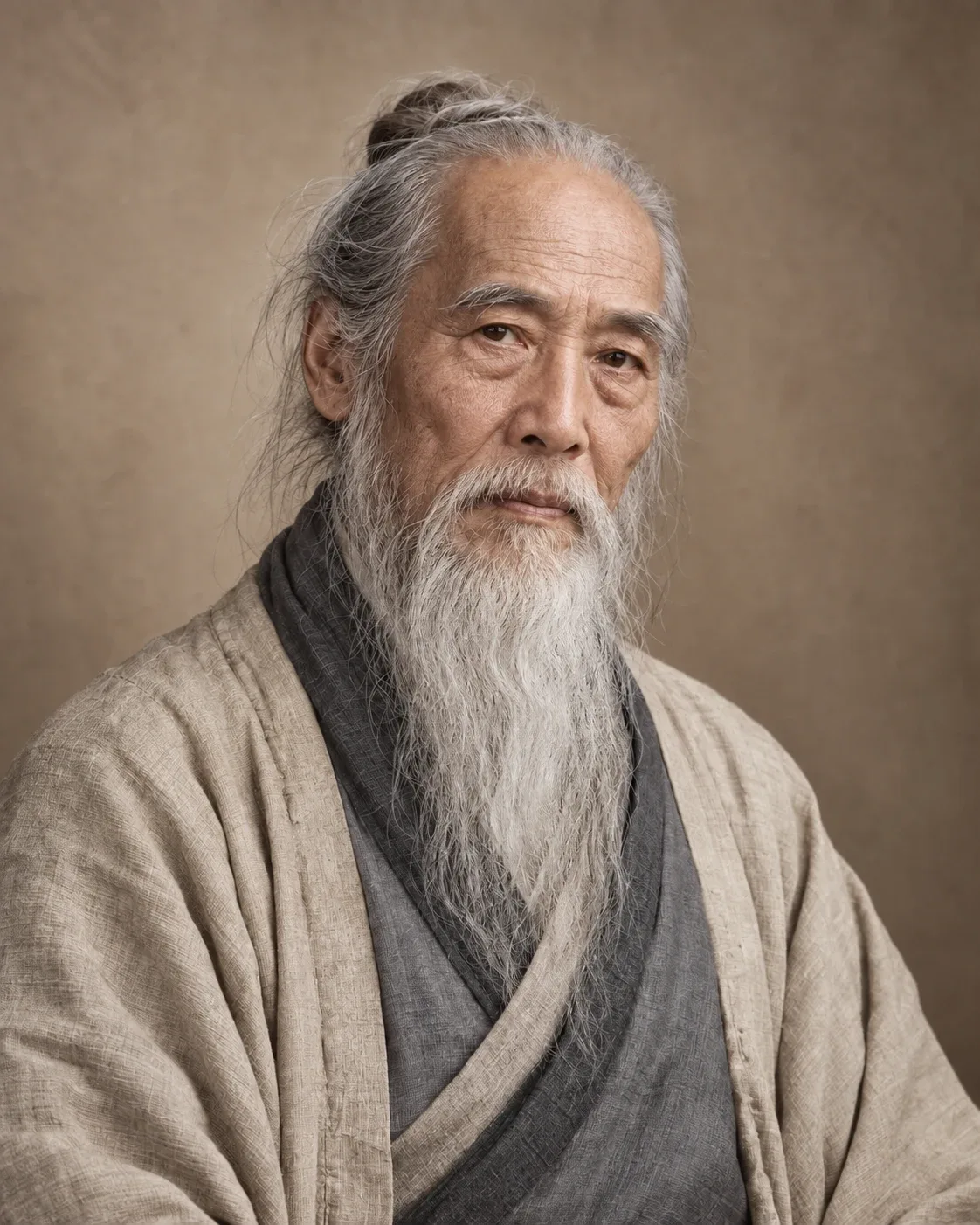
Begin with the space left by “a way that can be spoken”
Laozi draws readers in by questioning the confidence with which language names and controls the world. The Tao Te Ching opens by warning that a way fully captured in words is not the constant Dao. This is not an invitation to stop thinking. It asks us to notice what a definition excludes and to keep concepts responsive to changing reality. Water, valleys, infants, uncarved wood, empty vessels, and low places do philosophical work that a single abstract definition cannot do.
These images unsettle familiar equations between power and force. What yields may endure; what stays low may gather; what is empty may become useful; action may succeed by removing interference. Wuwei therefore does not mean blank inactivity. It names action without compulsive forcing, especially where rulers or ambitious individuals multiply controls until they damage the order they hoped to improve. The page follows these images across chapters so that Daoist terms remain connected with the patterns that give them meaning.
Read the chapters as echoes, not a straight argument
The eighty-one received chapters are brief, compressed, and sometimes deliberately paradoxical. Rather than searching for a linear proof, start with a cluster: Dao and naming in Chapter 1, water and non-contention in Chapter 8, wuwei in Chapter 37, and daily reduction in Chapter 48. Compare how an image returns with a different emphasis. Leave some ambiguity in place. That patience is more useful than immediately translating Laozi into management advice, self-help, or a doctrine that supposedly commands everyone to withdraw.
A life that resists a firm timeline
Records of the Grand Historian calls Laozi an archivist of Zhou but also preserves competing identifications, including Lao Laizi and Grand Historian Dan. Sima Qian himself leaves the question unsettled. Assigning him precise life dates or an itinerary would make the evidence look firmer than it is. The transmitted Tao Te Ching offers a surer starting point: naming in chapter 1 and water and non-contention in chapter 8.
Laozi, Li Er, and the long formation of the Tao Te Ching
Traditional biographies identify Laozi with names such as Li Er or Lao Dan and attribute the Tao Te Ching to him. Modern scholarship treats that neat picture cautiously. The text may preserve materials composed, collected, and edited over time. Manuscripts from Guodian and Mawangdui contain recognizable passages but differ from the familiar received edition in order and wording. Those physical witnesses make transmission history part of reading, not a footnote added after the philosophy.
This page keeps Laozi as the traditional figure through whom readers enter the work while separating biography, legend, manuscript evidence, and later Daoist religious images. Uncertainty is not a reason to avoid the classic. It is a reason to begin from passages we can compare. A chapter can be read closely even when the identity of a single author cannot be reconstructed with confidence. The distinction protects both the fascination of the tradition and the honesty of the historical account.
Core ideas
Dao
Dao names a source and pattern that cannot be exhausted by fixed names.
Wuwei
Non-forcing action removes excess control and lets things find their course.
Softness
Water, valleys, and softness show a resilient form of strength.
Representative passages
Dao and naming
道可道,非常道。
Start with the warning that a named way is not the constant Dao itself.
Read Chapter 1The image of water
上善若水。
Water shows how lowliness and benefit can become a model of strength.
Read Chapter 8Constant non-forcing
道常无为而无不为。
Wuwei is a disciplined pattern of action, not passivity.
Read Chapter 37Suggested reading path
- Start with the Tao Te Ching
Use the book structure before isolating famous lines.
- Chapter 1: The Constant Way
Begin with Dao and naming.
- Chapter 8: Like Water
Read non-contention through a concrete image.
- Chapter 37: Constant Non-Forcing
Connect wuwei with government and restraint.
Common misunderstandings
Wuwei does not mean doing nothing
It points to non-forcing action: removing excess control so action can fit the situation.
Laozi is historically complex
Traditional accounts connect Laozi with the Tao Te Ching; modern scholarship treats the person, text, and transmission with caution.
Softness is not weakness
Softness names a resilient way of responding without brittle force.